






|
Quantity
|
Price
|
||
|
|
|||
|
|
|||
Samsonite is not about one “perfect suitcase”. It is a range of different approaches to travel luggage. The brand’s collection includes ultra-light C-Lite models, practical polypropylene options such as Essens and Upscape, soft-sided Litebeam cases and more technical Proxis designs. So it makes sense to choose not only by looks or price, but by the way you usually travel.
Once you are on the move, you quickly realise that colour and shell design are not the only things that matter. The weight of an empty case, the way its wheels roll over paving, the feel of the handle, the layout inside and how comfortably it gets through a typical journey all make a difference - from leaving home and getting into a taxi to check-in and the baggage carousel.
Some travellers need a lightweight case so the suitcase itself does not take up too much of their airline allowance. Others want a rigid shell for frequent flights. For some, a soft-sided option with external pockets, expansion and room to add a few last-minute items makes more sense. Samsonite offers options for each of these travel habits.
Samsonite materials and collections
For travellers who put weight first, lightweight hard-shell models are worth a closer look. The C-Lite collection uses CURV®, a woven polypropylene material that makes the shell exceptionally light without making it feel fragile. It is a particularly practical choice for flights where every kilogram matters.
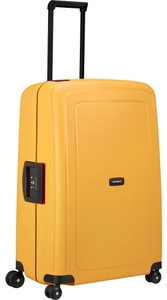
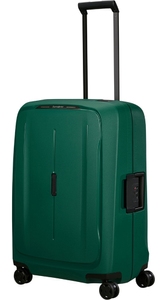
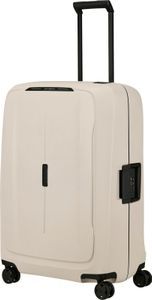
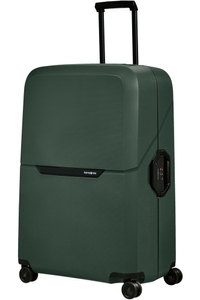
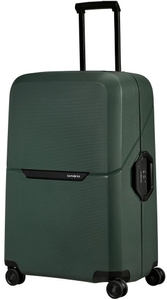
For a more familiar, all-round travel setup, consider polypropylene suitcases. Collections such as Essens, Upscape and Magnum Eco are a good fit when you want a lightweight rigid shell, clear internal organisation and luggage that feels equally at home in an airport, on a train or in the car.
Still, the overall experience is about more than the shell material. Sometimes what matters most is how smoothly the handle extends, whether the lock is easy to use, if belongings stay in place inside and how calmly the suitcase rolls over uneven paving or across a terminal floor. You notice these things most when packing runs late and the case needs to be closed just before you leave home.
Roxkin™ is another Samsonite material used in the Proxis collection. It is designed to remain flexible and recover its shape after stress. These models are worth considering for people who fly often, regularly check luggage and want a lightweight hard-shell suitcase with a more technical feel.
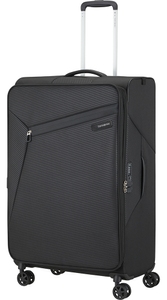
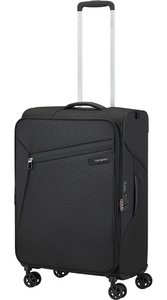
Soft-sided suitcases suit a different pace of travel. They work well for travellers who value external pockets, a more flexible shape and the ability to reach something on the move without opening the entire case. This format is especially convenient for train journeys, road trips, business travel and routes where your luggage stays close rather than disappearing into an aircraft hold.
Before buying, it is worth looking beyond the photos. One model may have an expandable section, another a front pocket, while a third may be lighter or better organised inside. Those details often prove more useful over time than the colour or texture of the shell.
How to choose the right Samsonite suitcase size
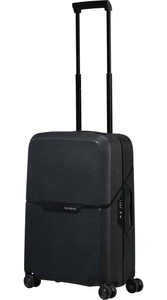
It is better to choose a size around the trips you actually take, rather than simply going for the biggest option. Carry-on suitcases are ideal for short flights and business trips when the dimensions of the particular model meet your airline’s rules. They are a good choice when you would rather keep your luggage with you and skip the baggage carousel after landing.
A medium suitcase is often the most versatile option. It usually has enough room for a week away: clothing, shoes, toiletries, electronics, spare outfits and a few small purchases picked up during the trip.
Large suitcases and XL models make more sense for family holidays, long journeys or trips where one case is packed for several people. The only thing not to overlook is that a large shell is easy to fill until it becomes awkward to lift, even with good handles and wheels.
What matters once you are on the move
Most modern Samsonite suitcases come with four wheels, and that makes a real difference in day-to-day travel. You can roll the case beside you, turn it in place, keep it next to you in a queue or move it across a terminal floor without pulling all the weight at an angle.
In product photos, many cases look broadly similar. The difference appears later: in a narrow train aisle, on uneven pavement, inside a hotel lift, at check-in or when one hand is holding documents and the other is guiding fully packed luggage.
That is why it helps to picture your usual route before you buy. How do you normally get to the airport? Do you need to carry the suitcase up stairs? How often do you check it in? Will you load it into a car? How much do you usually pack?
A Samsonite suitcase for the way you travel
It is easier to begin with size rather than colour or even a collection. First decide whether you need carry-on, medium or large luggage. Then think about what matters most for your trips: minimal weight, a rigid shell, soft-sided pockets or extra packing capacity. Only then compare the wheels, handle, internal layout, expansion and other details of a specific model.
That is when Samsonite becomes more than a familiar name on a shell. It becomes luggage that genuinely fits the way you travel.