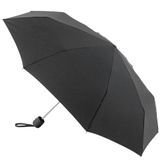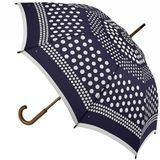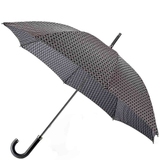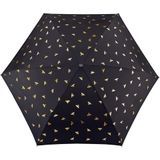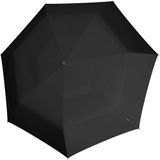
 An umbrella product page may mention eight ribs, fiberglass in the frame, an anti-wind system, or even testing at 120 or 150 km/h. But those specifications alone do not always tell you how an umbrella will behave in heavy rain or a strong gust of wind.
Umbrella testing looks at several things at once. The canopy may be turned inside out under load, the opening mechanism operated again and again, and the fabric exposed to water. Testers may also measure drying time, weight and dimensions. Wind performance can be assessed using controlled loads or a wind tunnel.
How umbrellas are tested for wind resistance
The same umbrella can behave very differently depending on the direction of the gust. Wind entering from underneath the canopy creates a different load from a headwind or a crosswind.
That is why a single figure in kilometres per hour does not tell the whole story.
One way to compare umbrella constructions is to measure how much force is required to turn the canopy inside out.
The umbrella is secured and the load is gradually increased until the canopy inverts. This allows different models to be compared under the same conditions and shows how easily their canopies turn inside out.
How the frame behaves under this kind of load is particularly relevant when looking at wind-resistant umbrellas. But an inverted canopy does not necessarily mean the umbrella is broken.
If the canopy turns inside out, is the umbrella ruined?
 Not necessarily.
After a strong gust, an umbrella can react in several ways:
- the canopy turns inside out and returns to its normal position;
- the ribs bend but recover their shape;
- the frame remains visibly deformed;
- a joint is damaged;
- a rib breaks;
- the opening mechanism stops working properly.
What matters is not only how difficult it is to invert the canopy, but also what happens to the structure afterwards.
In some cases, a flexible component that can bend and recover may be more practical than a very rigid one.
An inverted canopy does not automatically mean the umbrella has failed. What matters more is whether the structure recovers after the load and whether the umbrella continues to work normally.
A more rigid frame is therefore not necessarily better at handling a strong load.
An umbrella tested at 150 km/h – what does that mean in practice?
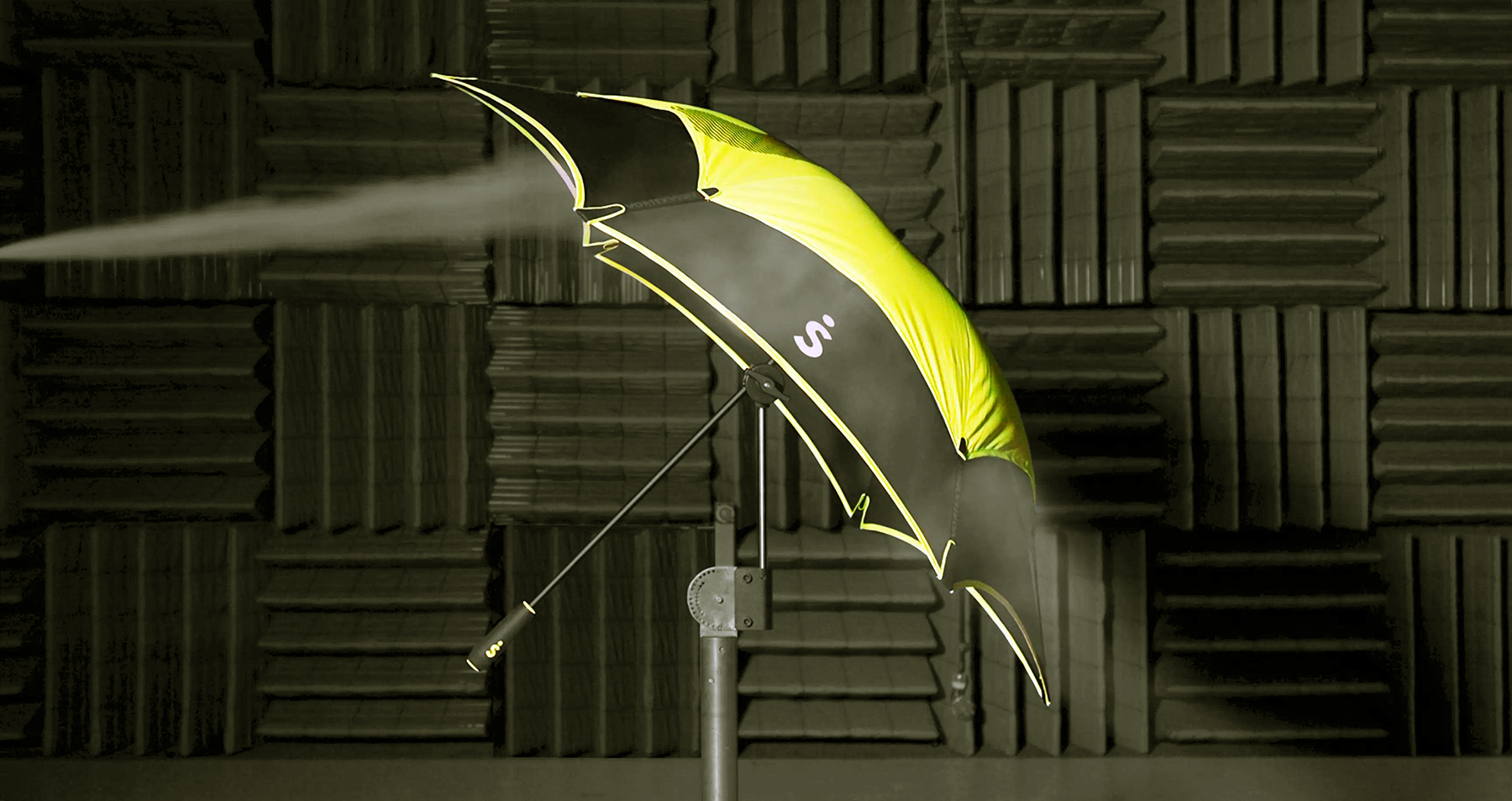
Another way to test an umbrella is with a controlled airflow.
The umbrella is placed in a wind tunnel and testers observe how the canopy and frame behave as the air speed increases.
This is how brands such as Knirps test some of their umbrellas. For certain models, the manufacturer states a specific test speed. For the Knirps T.200, that figure is up to 150 km/h.
Different umbrellas achieve wind resistance in different ways. A frame may be designed to flex more easily, the tension across the canopy may be distributed differently, or the umbrella may use a vented canopy that allows some of the air to escape.
That is why two umbrellas with the same number of ribs can behave differently in the wind.
Figures such as 120 or 150 km/h, however, are easy to interpret too literally.
If a manufacturer says that an umbrella was tested in a wind tunnel at a certain air speed, it does not mean that you can comfortably walk down the street with it in wind blowing at the same speed.
What the figure actually tells you is that the model was tested under controlled conditions at the stated airflow speed.
The result can depend on the position of the umbrella, the direction of the airflow, how long the load is applied, how the umbrella is secured and the criteria used to determine whether the test has been passed.
It is more accurate to say:
“According to the manufacturer, the Knirps T.200 was tested in a wind tunnel at airflow speeds of up to 150 km/h.”
Rather than:
“The umbrella can withstand any wind up to 150 km/h.”
The difference may look small, but the meaning is quite different.
How rain protection is tested
 There are two different properties that can be tested in umbrella fabric: how well the surface repels water and whether water penetrates through it.
If water beads on the surface and rolls off easily, the fabric has good water-repellent properties. But that alone does not describe the complete rain protection of a finished umbrella. Seams and the points where the fabric is attached to the frame matter as well.
When inspecting an umbrella, it therefore makes sense to look not only at the fabric itself, but also at the quality of the seams and how neatly the canopy is attached to the frame.
There is another characteristic that rarely appears on a product page: drying time.
The canopy can be completely soaked and then monitored to see how long it takes to dry.
This does not affect the structural strength of the umbrella. In everyday use, however, it can make a noticeable difference. After the rain, a wet folding umbrella may have to be left open in an office, car or café before it can go back into a bag or backpack.
For an umbrella used every day, drying time can therefore be a genuinely useful characteristic.
Why umbrellas are opened and closed hundreds of times
Before buying an umbrella, most people test the mechanism once or twice: open it, close it and make sure everything works.
That is not enough for a durability test.
An umbrella may be opened and closed dozens or hundreds of times. Afterwards, testers check whether the mechanism still operates consistently and whether any damage has appeared.
One successful press of the button says very little about long-term durability. Repeated opening and closing gives a much better indication of how consistently the mechanism works.
This is particularly relevant for automatic umbrellas, where the mechanism uses a button to both open and close the canopy.
Even during a simple in-store check, it is worth paying attention not only to whether the mechanism works, but whether it behaves the same way every time. Look for delays, incomplete opening or a noticeable change in the amount of force required.
How umbrella usability is tested
A strong umbrella is not necessarily a comfortable one.
That is why usability matters too: how easily the button can be pressed, how much force is needed to collapse the shaft, how the handle feels in the hand, how much the umbrella weighs and how much space it takes up.
The difference is particularly noticeable with full automatic umbrellas. Once the canopy has closed, the telescopic shaft still has to be pushed back into its original position. On one model this may require relatively little effort, while another may feel noticeably stiffer.
This is difficult to judge from a product page, but it is something you may notice every day once you start using the umbrella.
Size works in much the same way. Terms such as “mini”, “compact” or “extra-large” sound clear enough, but centimetres and grams give you a far better idea of what an umbrella will actually be like to carry.
If you carry an umbrella with you every day, it is worth looking separately at lightweight umbrellas. If it needs to fit into a small handbag or backpack, folded length becomes more important – in that case, small umbrellas are more useful to compare.
If the priority is more coverage for your shoulders, clothing or bag, the open canopy size matters most. You can compare these models separately among umbrellas with large canopies.
There is almost always a trade-off. A larger canopy provides more coverage, but usually requires a larger overall structure. A very light and short umbrella is easier to carry, but it is still worth checking the actual canopy size separately.
What you can check yourself before buying
You probably do not have a wind tunnel or measuring equipment at hand, but there are several useful things you can check in just a few minutes.
Open and close the umbrella several times. The mechanism should behave consistently, without sticking or stopping before the canopy is fully open. On an automatic model, also check how much force is needed to push the telescopic shaft back into place after the canopy closes.
Look at the frame. The ribs should open evenly, without obvious distortion or individual joints catching. A small amount of movement in the shaft of a folding umbrella can be normal, but pronounced wobbling or misalignment deserves attention.
Inspect the canopy. Look at the fabric tension, the seams and the points where the material is attached to the frame. There should be no obvious uneven sagging or distortion unless it is part of the intended design.
Hold the open umbrella in your hand. A few seconds is often enough to tell whether the handle feels comfortable, how noticeable the weight is and whether the umbrella feels too bulky for you.
Compare the actual measurements. Words such as “mini”, “compact” or “extra-large” tell you relatively little on their own. Folded length, weight and canopy size are much more useful points of comparison.
Check how the manufacturer describes wind resistance. There is a difference between a general “anti-wind” claim and a specific test result. If a speed in kilometres per hour is given, remember that it refers to a test carried out under particular conditions, not to a maximum wind speed in which you can safely or comfortably use the umbrella outside.
There is no single specification that defines a good umbrella. One person may care most about resistance to inversion, another about low weight and folded size, and someone else about having a larger canopy.
You do not need to reproduce laboratory tests yourself. It is enough to understand what the specifications on a product page actually describe and which of them matter most for the way you plan to use the umbrella.