



|
Quantity
|
Price
|
||
|
|
|||
|
|
|||
Suitcases with USB charging are useful when a phone, tablet, or earphones need a top-up at the airport, railway station, or while you wait for a flight. The external port lets you connect a cable without opening the suitcase or taking the power bank out of its internal pocket.
What distinguishes this luggage from a standard suitcase is not its own energy supply but a convenient connection point on the shell. Before buying, it is worth understanding how charging works on the specific model and what you need to bring.
The port is not a built-in battery
Most designs of this kind use a separate portable power bank. It sits inside the suitcase and connects to an internal cable or socket, while the external USB port carries power to the device. The port does not store energy and cannot charge anything unless a power bank is connected.
- Charge a compatible power bank before your trip.
- Place it in the designated pocket and connect it to the suitcase's internal cable.
- Use your own cable to connect the phone to the external USB port.
- Disconnect the device after charging and remove the battery before checking the suitcase.
This setup can power a phone, tablet, wireless earphones, and other compatible devices. Charging speed depends on the power bank, port type, cable, and device, not just the suitcase. A USB connector alone does not guarantee fast charging.
What to check on the product page
Start with the external connector: USB-A, USB-C, or a combination of the two. Then check the internal connection and whether it works with your battery. Port position, pocket access, and supported power specifications vary between models, so one cable setup should not be assumed to work across the entire category.
Package contents also matter. A power bank is often sold separately, while the suitcase may include only an integrated cable or adapter. If the product page does not state this clearly, confirm what is included before ordering.
Why size S is a common choice
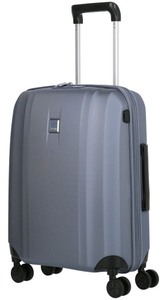
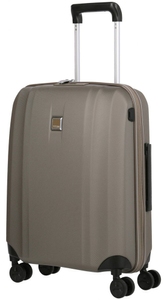
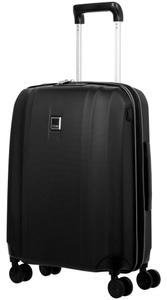
A small suitcase with a USB port is useful in the places where charging is most often needed: at the gate, in a security queue, or on the way to the hotel. Size S luggage stays with its owner, keeping the external port accessible without unpacking.
Dimensions around 55 × 40 × 20 cm are often considered for carry-on luggage, but an S label alone is not enough. Compare the full external measurements, including wheels and handles, the empty weight, and the rules of your airline. Opening an expansion section can also increase the depth.
Power banks and air travel
A power bank is treated as a spare lithium battery and must travel in carry-on luggage, not checked baggage. If a suitcase with charging is checked or taken from you at the gate, remove the battery first. Before flying, review the airline's limits for battery capacity and carriage.
How to choose a suitcase with charging
Once the USB setup is clear, compare suitcases for the trip itself: external dimensions, weight, shell material, capacity, and internal organization. Exact size and weight matter most for carry-on use; for checked luggage, prioritize quick access to the power bank before check-in.
At Koffer.UA, you can choose a suitcase with a USB port for short trips or checked luggage, compare model specifications, and confirm the package contents. Orders can be delivered across Ukraine, and selected models can be viewed at Koffer.UA stores in Kyiv after checking availability.