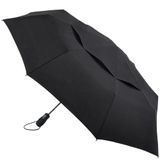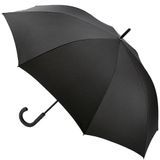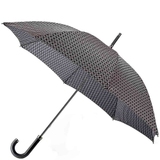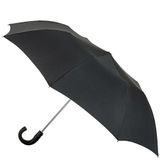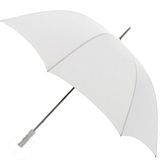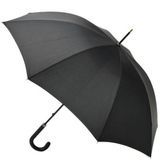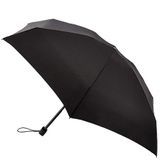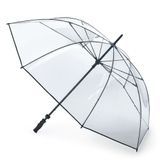
One umbrella lists polyester in its specifications, another lists pongee, and a third lists satin. They sound like three different materials. But pongee is often made from polyester, while satin describes a weave rather than the fiber itself.
Rain protection depends on how the canopy fabric is made and finished. Canopies can also look and feel quite different: some are soft and matte, while others are smooth with a noticeable sheen. Some are completely transparent. A material name alone doesn't always tell you what an umbrella will feel like once you pick it up.
What Materials Are Umbrella Canopies Made From?
Polyester
Polyester is a synthetic fiber used to make umbrella fabrics in a range of weights and textures. This gives you a choice between thin, smooth canopies and softer, matte ones. Taffeta, a fabric with a plain weave, may rustle slightly when the umbrella is folded, while softer fabrics tend to form less pronounced creases.
Even two canopies labeled “100% polyester” can differ considerably in yarn thickness, weave, and finish.
Polyester is used in umbrellas across different price ranges. Some specifications list rPET, which means recycled polyester. That tells you where the raw material comes from, not how well the canopy keeps out rain.
Pongee
Pongee is a type of fabric often made from polyester fibers in modern rain umbrellas.
It usually has a soft feel, a muted sheen, and a subtle texture. This finish appeals to people who prefer matte fabrics that don't rustle much when folded. Still, pongee fabrics can feel noticeably different from one manufacturer to another.
Pongee is often found in more expensive umbrellas. But the name on the label tells you little about the fabric's density, treatment, or expected lifespan.
Nylon
Nylon belongs to the polyamide family of fibers. It is used to make thin, flexible fabrics, including those with reinforced weaves.
The low weight of the fabric itself can be an advantage in compact folding umbrellas, although the frame and opening mechanism also contribute to the total weight. Nylon is used in both inexpensive and performance-oriented models. To help keep rain out, the fabric may receive a special treatment or an additional coating.
Satin and Jacquard
Satin has a smooth surface with a distinctive sheen. As the umbrella moves, light catches the fabric at different angles, making the shine especially noticeable. That's often the reason people choose satin canopies.
The name refers to the way the yarns are woven, not what they're made from. A satin canopy can be made entirely from synthetic fibers.
Jacquard is different: the pattern is woven directly into the fabric. It can stand out through color, texture, or a combination of both. This technique creates a distinctive design without printing a pattern onto the fabric's surface.
PVC and Transparent Canopies
Transparent umbrellas use polymer films, including PVC, instead of woven fabric. These are continuous sheets without interlaced yarns.
The main advantage of a transparent canopy is visibility. This is especially useful with deep, dome-shaped umbrellas: the canopy can cover the shoulders and part of the face without blocking the view ahead.
Film also behaves differently from ordinary fabric when folded, and the difference is noticeable along the creases.
What Determines How Well a Canopy Keeps Out Rain?
Water repellency and water resistance are different properties. A canopy can become wet on the outside and still keep the rain out.
A water-repellent treatment helps droplets bead up on the surface and roll off.
Resistance to water penetration describes how effectively a material prevents water from passing through it. The weave, fabric finish, and additional coatings all play a part.
For example, a polyurethane coating can improve a fabric's resistance to water penetration.
Over time, water-repellent treatments can become less effective, especially in areas that are repeatedly folded. After using an umbrella in the rain, it's best to leave it open to dry. Dirt can be gently removed with a soft, damp sponge if the manufacturer allows this type of cleaning. Some fabric canopies can be treated again to restore water repellency, but the product must be compatible with the fabric and its existing finish.
What Can Umbrella Fabric Specifications Tell You?
Labels such as 190T, 210T, and 75D describe properties of the fabric and yarn. Water Repellent and PU Coating refer to protective treatments or finishes.
| Label | What it means | What it doesn't tell you |
|---|---|---|
| 190T, 210T | A designation related to the number of threads in the fabric | How strong the canopy is or how effectively it keeps out rain |
| 75D | Yarn linear density | The weight or strength of the finished umbrella |
| Water Repellent | A water-repellent treatment | How resistant the fabric is to water passing through it |
| PU Coating | A polyurethane coating | The actual level of water resistance without test results |
For example, 210T is a higher number than 190T, but that doesn't automatically make the first fabric better. To compare them meaningfully, you'd need at least some information about the yarn and how the fabric was finished.
The 75D marking refers to the yarn itself. Denier is a measure of linear density: 9,000 meters of 75D yarn weigh 75 grams. But that figure alone can't tell you how strong the finished canopy will be or how much the entire umbrella weighs.
Fabric test results can reveal much more about its properties. However, manufacturers rarely provide that level of detail in listings for everyday rain umbrellas.
Which Canopy Material Should You Choose?
For an everyday rain umbrella, both smooth polyester taffeta and pongee can work well. If rain protection is your priority, the fabric's treatment and the build quality of the individual umbrella matter more. There's little reason to pay extra just for the word “pongee” in the specifications.
If appearance matters, close-up photos may tell you more than the material name. Better still, see the umbrella fully open in person.
When choosing a lightweight folding umbrella, pay attention to the weight of the entire model. The frame, shaft, and mechanism can contribute more to it than the canopy fabric.
What should you check before buying?
With the umbrella open, inspect the seams, the tension of the fabric, and the points where it attaches to the ribs. Uneven stitching or careless assembly should be easy to spot. However, even a flawless appearance won't tell you how waterproof the canopy is.
If the manufacturer doesn't provide detailed fabric specifications, other useful indicators are the umbrella's construction, the manufacturer's reputation, and the warranty terms.